


The film tells the story of how, against the backdrop
of the tense political climate between the Berlin and Cuban crises,
Benny Goodman’s orchestra arrived in the Soviet Union.
For the Soviet people in 1962, this was a tremendous breakthrough —
both in terms of international relations
and the rare opportunity to experience jazz music,
which was largely restricted at the time.
It also offered a rare chance to encounter
real Americans and their culture.

"Trojan Jazz" TRAILER

Giya KANCHELI, composer
I sorted out all these themes by ear, and played them on the piano. When I was invited to parties, I never danced with anyone, because I was sitting at the piano all the time. The others danced, and I just accompanied them. So I might say that my friendship with the music world began not with Mozart, Bach and Beethoven, but with Glen Miller, Ellington, Ella Fitzgerald, etc. It all started with a swing. Dissidents, defectors, anti-Soviets appeared later.


Summer 1962. The height of the Cold War. The first American jazz orchestra, led by Benny Goodman, embarks on a tour of the USSR — an event that took place between the Berlin and Cuban crises. For Soviet citizens, this was a unique opportunity not only to hear live jazz but also to see real Americans — free, relaxed, and completely different from people living in the USSR.
Benny Goodman and his orchestra performed in six cities: Moscow, Leningrad, Tbilisi, Sochi, Kyiv, and Tashkent. During the tour, 32 concerts were held, attended by about 200,000 people. Many compared their impressions of these concerts to Gagarin's space flight. One of the film's characters noted that if Lenin had emerged from the Mausoleum, it would have caused less of a shock than Benny Goodman's appearance on Red Square.
Jazz as a musical genre was almost banned in the Soviet Union, considered ideologically dangerous. The film tells the story of a legendary late-night jam session at Leningrad State University, where Soviet and American musicians played jazz together. In a country where communication with foreigners culd lead to serious consequences, these people took risks for the sake of art. Soviet musicians secretly shared the sheet music of their compositions with the Americans, who later released the world's first album of Soviet jazz.
Jazz became a symbol of freedom in a totalitarian country, awakening a spirit of independence in those who lived under the weight of Soviet ideology. Composer Gia Kancheli, one of the film's characters, notes, “It all began with swing. Later, dissidents, defectors, and anti-Soviet activists emerged. The foundations of the totalitarian regime began to crumble precisely when swing arrived in the Soviet Union.”
One of the film’s most dramatic episodes is the story of Ukrainian flutist Grigory Fedkin, to whom Benny Goodman gifted a flute. The next morning, the chairman of the Broadcasting and Television Committee demanded that the instrument be handed over to the state, claiming it was intended for the entire orchestra. Despite threats, Fedkin refused and was soon dismissed from the orchestra. He was forced to leave his musical career and make a living by repairing instruments and playing at funerals. He lived in a small town near Kyiv, Irpin, where, in the spring of 2022, war would arrive...
The film features prominent figures such as musician Bill Crow, author of the book about the tour "To Russia Without Love"; composer Gia Kancheli; Nikita Khrushchev’s son, Sergei; journalist Vladimir Pozner; musicians Seva Novgorodsev and Gennady Golshtein; tour producer George Avakian; and the son of the orchestra's trumpeter Jimmy Maxwell — David, for whom this trip was life-changing. He later became a renowned Slavic studies scholar and professor of Russian language and literature in the United States.
The film also draws parallels with modern times, showing Russia, where musicians, performing in the garden of a retirement home for retired actors, learn that part of their park has been taken by individuals connected to the KGB. Meanwhile, in Ukraine, a large banner hangs on Maidan Square with the words, "Freedom is our religion." And today’s war between Ukraine and Russia is not just a struggle over territory or political interests. It is a war between Russia’s revival of a totalitarian past and a future where Ukraine defends not only its independence but also a core value system centered on human dignity and freedom. Unique footage of pre-war Irpin, destroyed by Russian forces in the spring of 2022, with the figure of a flutist on the central square, serves as a poignant reminder of Ukraine’s ongoing struggle for freedom and independence.
SYNOPSIS

In our film, jazz is not only a unique musical genre
that emerged in America in the early 20th century but,
above all, an embodiment of Freedom—
in music, self-expression, and attitude toward life


The Beginnings
Soviet jazz emerged in 1922 when the debut of the first domestic jazz ensemble, a so-called "jazz band," took place in the Soviet capital. The premiere was held in mid-autumn of 1922 in the Great Hall of the State Institute of Theater Arts. The honor of popularizing jazz in the USSR initially fell to Kharkiv native Yuliy Meitus and Moscow-based Leonid Varpakhovsky, who organized ensembles inspired by the music they heard during the 1926 tour of American jazz bands led by Frank Withers in Soviet Russia. In the same period, the operetta "Chocolate Kiddies" was performed in the USSR, with Sam Wooding conducting the orchestra.
In 1927, Alexander Tsfasman formed the musical ensemble "AMA-jazz" in Moscow, while in Leningrad, Leopold Teplitsky created his jazz orchestra. These two ensembles marked the beginning of professional Soviet jazz. Their concert programs largely consisted of Western compositions. The People’s Commissariat of Education even sent Teplitsky to the United States, where he studied music for silent films and was particularly impressed by Paul Whiteman’s orchestra, known for its symphonic jazz style.
In 1929, Boris Krupyshev and Georgy Landsberg founded the "Leningrad Jazz Chapel" in the northern capital, performing Western pieces and original compositions by young Soviet composers such as Nikolay Minkh, Heinrich Terpilovsky, Alexei Zhivotov, and others. This ensemble existed until 1935. In early 1929, trumpet player Yakov Skomorovsky and actor Leonid Utyosov from the Leningrad Theater of Satire created the "TEA-jazz," presenting jazz in a theatrical format with its own script, hosting, dancing, and variety acts. The orchestra collaborated with composer Isaak Dunayevsky. Around the same time, Alexander Varlamov, Alexander Tsfasman, Georgy Landsberg, and Yakov Skomorovsky established jazz ensembles that shone on the Soviet jazz scene and began recording records.
During the 1930s, Soviet jazz orchestras increasingly performed pieces by Soviet composers such as Daniil and Dmitry Pokrass, Leonid Diderichs, Alexander Tsfasman, Alexander Varlamov, Yuliy Khait, Nikolay Minkh, Georgy Landsberg, and Heinrich Terpilovsky. Isaak Dunayevsky gained fame for his rhapsodies, while Alexei Zhivotov and Dmitry Shostakovich became known for their jazz suites. In 1938, conductor Viktor Knushevitsky and artistic director Matvey Blanter completed the creation of the State Jazz Orchestra in Moscow. Around this time, Alexander Varlamov founded the All-Union Radio Committee Orchestra, later led by Alexander Tsfasman. By the late 1930s, jazz could be heard on Soviet radio stations, and in 1940, Nikolay Minkh formed his orchestra at Leningrad Radio.
The History of Soviet Jazz


1940s and 1950s
When the WW2 began, Soviet jazz musicians, including Nikolay Minkh, Yakov Skomorovsky, Yuri Lavrentiev, Boris Rensky, Isaak Dunayevsky, Leonid Utyosov, Dmitry Pokrass, Klavdiya Shulzhenko, Boris Karamyshev, Viktor Knushevitsky, Alexander Varlamov, and many others, toured the frontlines with their orchestras. During this period, Vasily Solovyov-Sedoi composed the famous song "Evening on the Roadstead" and Nikita Bogoslovsky wrote "Dark Night." After the war, a variety orchestra of wartime jazz musicians was formed under the direction of Viktor Knushevitsky at All-Union Radio.
In 1946, Alexander Tsfasman worked to establish the large "Sympho-Jazz" orchestra based at the Hermitage Theater. After the war, jazz enthusiasts in Moscow flocked to the Metropol Restaurant to hear performances by the popular ensemble featuring Sergey Sedykh on drums, Alexander Rozenwasser on double bass, Viktor Andreev and Leonid Kaufman on piano, Yan Frenkel on violin, and Alexander Rivchun on tenor saxophone and clarinet.
The late 1940s is considered one of the most challenging periods in Soviet jazz history. This was the era of the fight against "cosmopolitanism," targeting the influence of "bourgeois" Western culture. On February 10, 1948, the Politburo of the Central Committee of the CPSU issued the infamous decree "On the Opera The Great Friendship by Vano Muradeli," condemning the "formalist direction foreign to the Soviet people." This initiated a hunt for anything that could be labeled as "bourgeois" art, which naturally included jazz as "Western" music. Interestingly, jazz was never officially banned, even at the height of the anti-cosmopolitan campaign. However, jazz musicians and ensembles faced harsh "criticism," which amounted to severe persecution, and certain instruments associated with jazz were even banned. This persecution only ceased with the beginning of Khrushchev’s "Thaw."
In the 1950s, Vladimir Rubashevsky founded a dixieland band in Moscow, specializing in jazz standards and compositions by Soviet composers.
Around the same time, Oleg Lundstrem arrived in Moscow with his jazz orchestra, originally based in Kazan. His ensemble performed both original compositions and jazz pieces inspired by folk motifs. Starting in the late 1950s, Lundstrem and his orchestra relocated to Moscow, and they quickly became recognized as one of the finest jazz ensembles in the country. In the 1950s, Matvey Blanter and Isaak Dunayevsky composed songs that entered the golden repertoire of Soviet jazz. Other composers, including Boris Mokrousov, Nikita Bogoslovsky, and Vasily Solovyov-Sedoi, also wrote compositions for orchestras, often lighthearted or humorous, which were performed by both large ensembles and improvisational "combo" groups. Additionally, Soviet composers such as Vano Muradeli, Andrei Eshpai, Arno Babajanyan, and Tikhon Khrennikov composed songs for orchestras during this period.


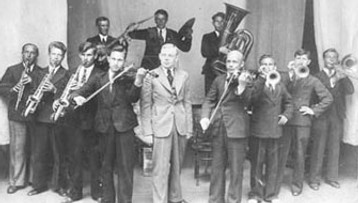

1960s
In the 1960s, Soviet jazz began a new phase of development, establishing itself as not only an entertainment genre but a respected form of musical art. Jazz started being studied in music schools and conservatories, with new styles and branches emerging. Jazz compositions began to incorporate the folk music traditions of the Soviet republics, and the skill level of Soviet musicians improved significantly, with large orchestras showcasing more refined ensemble work. A generation of young musicians emerged, mastering improvisation as proficiently as their foreign peers.
One prominent group from this period, the "Golden Eight," included drummer Alexander Salganik, pianist Yuri Rychkov, trombonist Konstantin Bakholdin, trumpeter Viktor Zelchenko, and saxophonists Alexey Zubov and Georgy Garanian. They performed in the Central House of Art Workers orchestra, initially led by Boris Figotin and later by Yuri Saulsky. This orchestra won a silver medal in a jazz competition at the 6th World Festival of Youth and Students in Moscow, where Soviet musicians had the chance to interact with international jazz artists.
In 1958, a jazz club was established in Leningrad, followed by one in Moscow two years later, with support from local Komsomol committees. These jazz clubs quickly spread across the USSR, forming networks that hosted jazz ensembles, lectures, and sessions for studying foreign and Soviet jazz music.
The 1960s also saw the formation of notable jazz groups. Young people attended concerts by the Leningrad Quintet led by Vladimir Rodionov, Yuri Vikhariev’s quartet, and traditionalist bands like "Doctor Jazz" and "Seven Dixieland Boys." These ensembles performed music by Soviet composers, arranged their pieces, and composed original works.
At the same time, amateur jazz groups began to emerge across the Soviet Union, serving as a training ground for future professionals. By the late 1950s and early 1960s, small "combo" ensembles featuring members from the "Golden Eight" began recording sessions. These sessions, involving Moscow pianist Boris Rychkov and Leningrad trumpeter Herman Lukyanov, became the first professional recordings recognized as part of the new wave of Soviet jazz.
Esteemed Soviet composers began welcoming prominent jazz musicians into their professional union. Among these were notable figures such as Valter Ojakäär, Uno Naissoo, Konstantin Orbelyan, Yuri Saulsky, Vladimir Terletsky, Vladimir Rubashevsky, Murad Kazhlaev, Igor Yakushenko, and Bohdan Trotskyuk. Their works were recorded on vinyl, broadcast on Soviet radio, and performed at concerts.
From the 1960s onward, Soviet musicians participated in jazz festivals across the USSR and in the post-Soviet space. Renowned festivals included those in Tbilisi, Novosibirsk, Donetsk, Yaroslavl, and Leningrad. In 1967, Tallinn hosted Soviet jazz ensembles along with performers from Switzerland, Finland, Sweden, and Poland.
In 1962, the first international tour of a Soviet jazz group, featuring Nikolai Gromin, Andrei Tovmasyan, and Alexey Kozlov, took place at the Jazz Jamboree festival in Warsaw. After that, Soviet musicians began regularly touring abroad. During the Soviet era, artists like Anatoly Kroll, Konstantin Orbelyan, Oleg Lundstrem, and Vadim Lyudvikovsky performed with their orchestras in the capitals of Czechoslovakia and Poland, while "Leningrad Dixieland," Nikolai Gromin, and Georgy Garanian with their ensembles gained popularity in Prague.
The Benny Goodman Orchestra Tour in the USSR
In 1962, the legendary American clarinetist Benny Goodman embarked on a groundbreaking two-month tour across the USSR with his orchestra. Goodman and his band performed a total of 32 concerts in Leningrad, Moscow, Kyiv, Tashkent, Tbilisi, and Sochi, drawing over 180,000 attendees. Soviet audiences greeted and bid farewell to Goodman and his musicians with standing ovations, calling them back for encores up to ten times. The crowd often refused to leave until the lights were turned off. The orchestra members were stunned by the warm reception, as none had anticipated such a response. Goodman himself was fascinated by the fishing, the majestic concert halls, and the Russians' "sense of swing." Among the audience members were notable figures, including Nikita Khrushchev and Alexei Kosygin, although Khrushchev reportedly left after the first set, complaining that "these jazz tunes" gave him a headache.
Soviet jazz musician Sergey Lavrovsky recalls: "The arrival of Benny Goodman's orchestra in Leningrad in June 1962 was perhaps the most significant event in the entire history of our first jazz club. It was a revolutionary moment for jazz, not only in Leningrad but throughout the USSR. The musicians’ visit gave us a huge boost. Of course, we tried to connect with the musicians; we were eager to speak with them. But a jam session with the Americans was out of the question. So we decided to arrange one in secret, at night, at the university. We brought our instruments—pianos, drums, a double bass—and snuck the Americans in by boat. The jam session went on until they couldn’t sit any longer. It was an incredible experience; we got to see how American musicians played compared to our local stars."
The jam session at Leningrad University was an unofficial highlight, made possible largely through the efforts of pianist, composer, and jazz enthusiast Yuri Vikhariev, the club president and a passionate jazz advocate. In his book, Memories of Jazz, Vikhariev shares: “Our joy knew no bounds, even though many musicians were initially disappointed by the choice of Goodman for this historic tour—why not Armstrong, Ellington, or Fitzgerald? Still, when we learned of Goodman’s lineup, excitement replaced disappointment: trumpeter Joe Newman, saxophonists Phil Woods and Zoot Sims, trombonist Jimmy Knepper, and drummer Mel Lewis! We were filled with anticipation."
One of the tour's most notable events was a midnight jam session at Leningrad University, organized by jazz fans who spirited American musicians from a concert at the Astoria Hotel to the university under cover of night. There, they played jazz standards like "How High the Moon" and "Avalon" until early morning, despite repeated attempts by the university guard to end the session.
Soviet saxophonist Gennady Golshtein, known as “Charlie,” shared his thoughts: “That night, we truly experienced swing. As soon as the Americans joined us, everything came alive with rhythm and energy. We learned so much just by watching and listening, as they gave jazz a pulse and meaning we had never achieved on our own.” This secret jam session became a legend among Soviet jazz musicians, demonstrating the energy and artistry of American jazz firsthand.
Following the tour, Gennady Golshtein sent his compositions to New York with the help of American musicians. In the following year, New York jazz stars Vic Feldman, Phil Woods, and Zoot Sims played his pieces on Radio Liberty, referring to Golshtein anonymously as "a Soviet jazz composer" to avoid repercussions for him back in the USSR. Later, they released an album titled Vic Feldman and the Stars Play the First Soviet Jazz Album, marking a unique crossover between Soviet and American jazz.

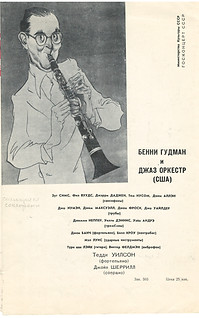


Behind the FILM: Full Interviews
GEORGE AVAKIAN
Producer of the USSR Tour
BILL CROW
Bassist for Benny Goodman’s orchestra
during the USSR tour


GIYA KANCHELI
Famous Georgian composer
JULIAN MILKIS
Clarinetist, student of Benny Goodman


VLADIMIR POZNER
Russian-American journalist and presenter

Sergei Khrushchev
Nikita Khrushchev's son

David Maxwell
son of jazz trumpeter Jimmy Maxwell

ROMAN KOFMAN
Ukrainian composer and conductor

SCREENINGS

SCREENINGS
•RTVi – 2024-11-14
•Los-Angeles – 2024-08-26
•RTVi – 2023-09-21
•Boston, USA – 2023-03-29
•Sofia, Bulgaria – 2022-08-21
•Varna, Bulgaria – 2022-08-21
RTVi – 2022-07-23
•Sofia, Bulgaria – 2022-05-01
•Sofia, Bulgaria – 2022-04-26
•Sofia, Bulgaria – 2022-04-14
•Plovdiv, Bulgaria – 2022-04-12
•TV Rain – 2022-01-09
•TV Rain – 2021-06-07
•Kyiv, Ukraine 2021-06-06
•RTVi – 2021-10-17
•TV Rain – 2021-05-10
•TV Rain – 2020-02-27
•RTVi – 2019-11-27
•Irpin, Ukraine – 2019-10-25
•Yekaterinburg, Russia – 2019-10-04
•Claryville, NJ, USA – 2019-09-29
•St. Petersburg, Russia – 2019-06-08
RTVI
14 November 2024

Los-Angeles, USA
LA Independent Film Festival, 26 August 2024


Boston, USA
29 March, 2023


Sofia, Bulgaria
Sofia Summer Fest
21 AUGUST 2022

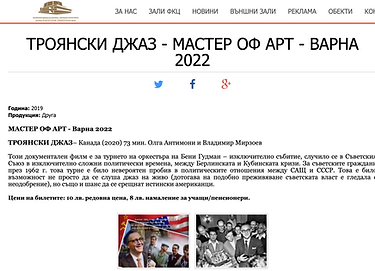
VARNA, Bulgaria
21 AUGUST 2022
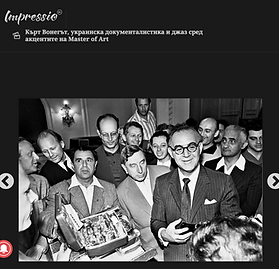
RTVI
23 July 2022


Sofia, Bulgaria
CINEMA ODEON
1 May 2022


Sofia, Bulgaria
National Palace of Culture
26 April 2022

PLOVDIV, Bulgaria
Cinema Lucky "Dom na Kinoto"
12 April 2022


TVRain
09 January 2022


RTVI
17 October 2021
TVRain
07 Juin 2021
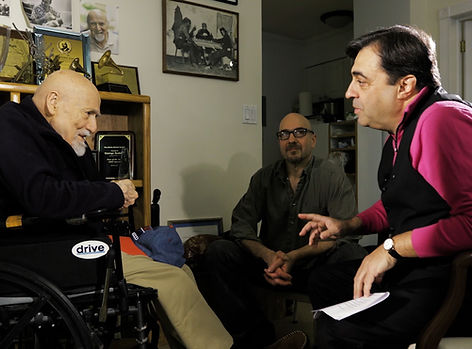
TVRAIN
10 May 2021

KYIV, UKARINE
6 Juin 2021


TVRain
27 February 2020

TVRAIN
01 February 2020

RTVI
27 November 2019

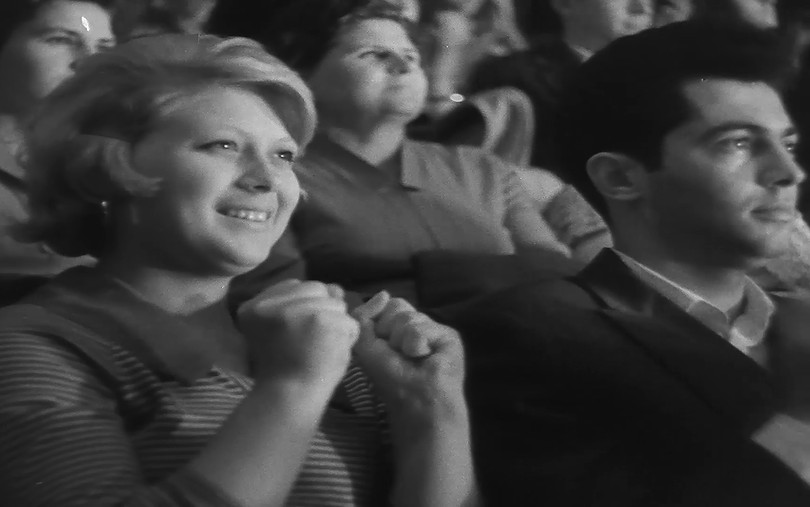
RTVI
10 October 2019
Irpin,
Ukraine
25 October 2019


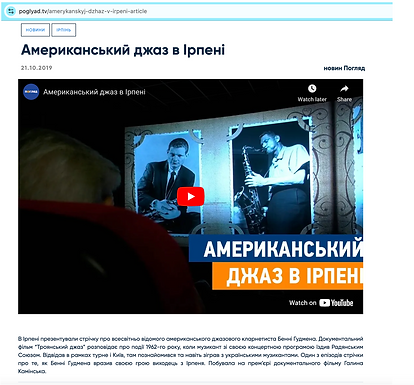


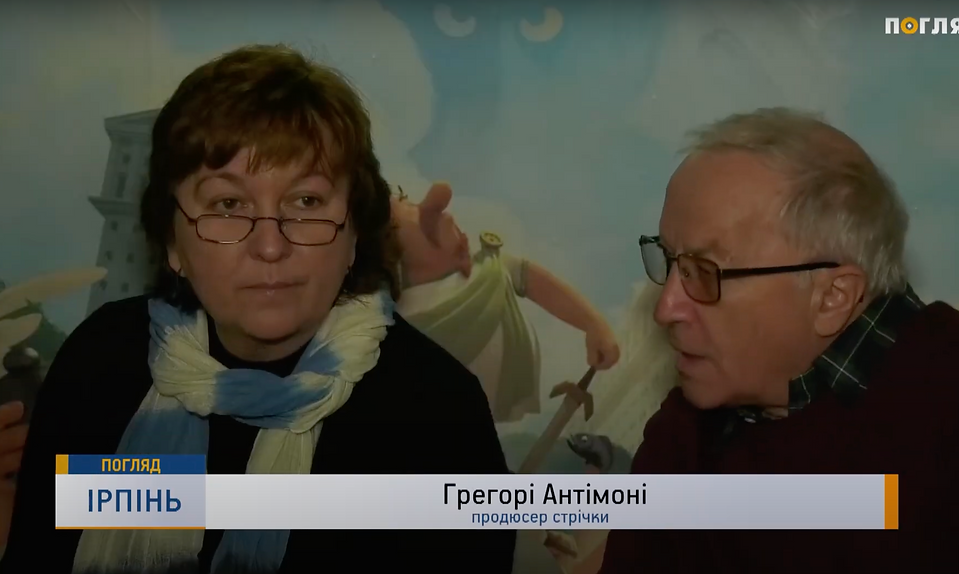
Claryville, NY, USA
Claryville Film Festival,
29 September 2019


St. Petersburg, Russia
State Academic Capella,
8 June 2019


FILMMAKERS

Olga ANTIMONY
She is a documentary film director of Ukrainian origin. She graduated from Moscow State University with a degree in "Television Journalism" and the Higher Courses for Scriptwriters and Directors. In 2010, she moved to Canada at the invitation of the television company Ethnic Channels Group, where she is a director of several television projects and a director and creative consultant of documentary films (“Maya: Death or Awakening of Humanity?” (2012), “Photo album” (2012), “Under Yellow and Red Stars” (2012-2014), Darkness Casts No Shadow (2016), Sounds of Canada (2017–2021), In Fantasy I Will Be Bathed in Tears (2018), Trojan Jazz (2019), Dream Big. Through Hardship to the Stars (2019), Crazy Canuck Collections (2019), YIiddish Sounds of Canada (2021), Giya Kancheli: I Used to Hate Clarinet (2020), Gulag. Witnesses (2021–2025), Mary Pickford's Kiss (2024), and others.
Vladimir MIRZOEV
In 1981, he graduated from the directing department of GITIS. In 2001, he received the State Prize of the Russian Federation for achievements in literature and arts in 2001. In March 2010, he signed the Russian opposition's petition "Putin Must Go." From 1987 to 1989, he served as the artistic director of the "Domino" Theater Studio in the Creative Workshops at the Union of Theater Workers of Russia. In December 1990, he founded the theater company "Horizontal Eight" in Toronto, Canada. He has directed productions at the K.S. Stanislavsky Theater, the Evg. Vakhtangov Theater, Lenkom, and the Russian Drama Theater in Vilnius. He has taught and conducted master classes at the University of Michigan, the University of Toronto, York University (Toronto), and others. He is the author of films such as My First Teacher, or a Bachelor Party in the Russian Style, Love, Amphitryon, Four Loves, The Man Who Knew Everything, Boris Godunov, and others.


Gregory ANTIMONY
American-Canadian producer with a rich history of crafting impactful media projects. Born in Ukraine and raised in Kolyma, Gregory holds a Ph.D. in neurophysiology and previously served as an assistant to the legendary Yuri Lyubimov at the Taganka Theatre. After emigrating to the U.S. in 1991, he founded Wostok Entertainment, producing television programs for Russian-speaking audiences and later became CEO of NTV America. Gregory has a strong track record in documentary filmmaking, having produced award-winning works such as Vysotsky in America, Sounds of Canada (2017–2021), Trojan Jazz (2019), GULAG. Witnesses (2020-2024), and Mary Pickford's Kiss (2024). His projects have received accolades at international film festivals, showcasing his ability to tell powerful, culturally resonant stories. Currently, he also hosts Interview Hour on RTVi, where he continues to engage audiences with thought-provoking conversations.
Felix GOLUBEV
Canadian Emmy Award-winning producer known for creating groundbreaking documentaries with global impact. Born in St. Petersburg, Felix graduated from the prestigious Radio and Television Arts program at Ryerson University in Toronto. His films have been featured at over 40 international festivals and aired in more than 50 countries. Notable works include Atlantis Rising (National Geographic, with James Cameron), Tales From the Organ Trade (HBO, 2013), Enslaved (2020), and The Exodus Decoded (History Channel and Discovery Canada). Recent projects such as Beasts of the Bible (National Geographic), Charging the Rhino (VisionTV Canada), and The Lost Tomb of Jesus (Discovery USA, Channel 4 UK) have further cemented his reputation. His work as an executive producer on Impact of Terror for CNN earned the Overseas Press Club of America Award in 2005. Felix’s commitment to storytelling continues to resonate with audiences worldwide, bringing compelling narratives to life with precision and depth.


Serhiy TAKHMAZOV
Serhiy Takhmazov is a Ukrainian cinematographer with over three decades of experience in film, television, and media training. A graduate of Kyiv University with degrees in journalism and law, Takhmazov has played a significant role in advancing visual storytelling both nationally and internationally.
His filmography includes acclaimed works such as “Between War and Peace” (2011), “To the East” (2015), “Ticket to Amsterdam” (2017), “Chronicles of the Seventh Company” (2019), “Gia Kancheli: I Used to Hate Clarinet” (2020), and “And I’m Still Alive” (2021). In 1997, he participated in Steven Spielberg’s Holocaust project, documenting Ukrainian video testimonies that became foundational for “Schindler’s List.”
For his achievements, Serhiy Takhmazov has received numerous accolades, including the Ministry of Defense of Ukraine’s "Badge of Honor," the "For Assistance to the Armed Forces" medal, the brigade badge "Pectoral Cross" from the 17th Separate Tank Brigade, and a certificate of appreciation from Ukraine's Minister of Defense.
Yury BURAK
Yuri Burak is a director of photography known for his work in both documentary and feature films. He has collaborated with major international broadcasters and news agencies, including Associated Press, WTN, Fox News, ABC News, ARTE, BBC2, Discovery, and National Geographic. Among his works is the documentary Iraqi Odyssey, nominated by Switzerland for an Academy Award in 2015. His filmography includes projects such as A Prayer for Beslan (2004), Lake Baikal (2010), Journey from St. Petersburg to Moscow (2010), Michael Jackson: Moscow Case (2011), as well as Trojan Jazz (2019) and Giya Kancheli: I Didn’t Like the Clarinet (2020). Since 2020, he has been based in Estonia, focusing on international co-productions of feature and documentary films. Yuri has also collaborated with directors like Werner Herzog and continues to work on projects that require unconventional cinematography to convey unique stories and natural locations.


Vladimir STRUNGAR
Vladimir Strungar is a director of photography who emigrated from Moldova to Canada in 2012, with extensive experience in documentary, commercial, and studio production. Known for his artistic approach, he has contributed to projects such as Darkness Casts No Shadow (2016), Sounds of Canada (2018–2021), In Fantasy I Will Be Bathed in Tears (2018), Trojan Jazz (2019), Dream Big. Through Hardship to the Stars (2019), Crazy Canuck Collections (2019), Giya Kancheli: I Hated the Clarinet (2020), Gulag. Witnesses (2021–2025), Yes, You Can! (2023), Ukrainian Mothers (2023), Taiko (2023), Mary Pickford's Kiss (2024), and others. His work has been recognized at various festivals, and for the project Sounds of Canada, he was awarded by the Canadian Ethnic Media Association for original visual solutions. Vladimir actively uses advanced cinematography technologies, bringing a unique vision to each project. He is fluent in English, Romanian, and Russian.
MIROSLAV DELEV
Miroslav Delev is a sound editor and mixer with over twenty years of experience in audio production for film, television, and advertising. A graduate of New Bulgarian University in Sofia with a degree in sound engineering, he has worked on various projects in Bulgaria, Spain, and Canada. His portfolio includes sound design for documentaries such as Sounds of Canada (2017-2021), which was recognized by the Canadian Ethnic Media Association, In Fantasy I Will Be Bathed in Tears (2018), Trojan Jazz (2019), Dream Big. Through Hardship to the Stars (2019), Crazy Canuck Collections (2019), Giya Kancheli: I Hated the Clarinet (2020), Gulag. Witnesses (2021–2025), Yes, You Can! (2023), Ukrainian Mothers (2023), Taiko (2023), Mary Pickford's Kiss (2024), and others. Miroslav has also collaborated with channels like Fox International and Ethnic Channels Group, and since 2014, he has been working with ECG Productions in Canada, specializing in sound editing, mixing, and music recording. Proficient in audio software such as Pro Tools, Izotope RX, and DaVinci Resolve, he works in multiple languages, including English and Bulgarian.
.jpg)

Serhiy PROKOPENKO
Serhiy Prokopenko is a sound engineer with extensive experience in clean sound recording and audio post-production for film and television. A graduate of the Poltava Music School named after M.V. Lysenko, Serhiy has built a diverse portfolio of projects across Ukraine, Georgia, the USA, Sweden, and Switzerland. His credits include sound recording and post-production for feature films such as Forebodings (2019), I and Felix (2020), and Stepne (2020). He has worked on documentaries like Ramblin' Jack. Beyond the Music (2019), Ballroom King (2019), and The Invasion (2023). Serhiy’s expertise extends to short films, including Wooden Wedding (2022), MAM (2020), and KingDoom (2019).
Serhiy has collaborated with prominent directors such as Vyacheslav Kryshtofovych, Darya Onishchenko, Iryna Tsylyk, and Maryna Vroda, as well as international broadcasters like RTVi and TVRain. Known for his meticulous attention to detail and creative approach to sound design, Serhiy plays a key role in bringing cinematic stories to life. His work reflects a commitment to technical precision and storytelling, making him a sought-after professional in the field of audio production.
Irina VOLKOVA
Irina Volkova is a highly acclaimed filmmaker known for creating innovative works that push boundaries, champion original perspectives, and drive cultural and social impact. As a director, writer, and producer, Irina explores themes such as diversity, equality, inclusion, and human rights. Her storytelling emphasizes point-of-view narratives, capturing the multiplicity of Canadian perspectives and resonating with audiences both locally and globally. Through her unique artistic vision, Irina connects with viewers on an emotional level, combining creative ideas with compelling expression. Over the years, she has cultivated strong relationships with more than 20 ethnic communities in Canada, showcasing their stories and experiences. Irina thrives in fast-paced, collaborative environments that encourage creative thinking and uncompromising storytelling.
Her filmography includes notable works such as Sounds of Quebec (2019), Expelled from the Top (2021), When the Monuments Speak (2022), We Shall Not Sleep (2023), and Israel: Unity in Despair Screener (2024).


Yulia ORLENKO
Yulia Orlenko is a producer, screenwriter, and director with a background in journalism from Taras Shevchenko Kyiv National University and advanced studies at the Wajda School and Studio in Poland. She has honed her craft through numerous workshops in screenwriting, directing, and acting in Ukraine and Poland. Awarded a scholarship by the Polish Minister of Culture, she developed her debut feature-length project, Second Wind. Since 2016, Yulia has been working as a director and editing director at the Canadian production studio ECG. Her filmography includes The Goldfish (2023), Home (2023), Wooden Wedding (2022), the children’s series Mama Canada (2020–2022), Night on Ivan Kupala (2021), and Crazy Canuck Collections (2018–2020). She also worked as a screenwriter for the documentary series The Game of Fate. Yulia’s work is recognized for its cultural resonance and innovative storytelling across genres.
Ruslan SMAKOV
Ruslan Smakov is a producer, editor, director, and presenter who graduated from Dnipropetrovsk University with a degree in Journalism and the National Academy of Public Administration under the President of Ukraine. Completed internships at the Robert F. Wagner Graduate School of Public Service at New York University and at the Maastricht Institute of Governance. He headed the Directorate of Information Programs of the Dnipropetrovsk Regional Television and Radio Company. He initiated the author's television program cycles "Southern East" and "Seven Questions to the President". In collaboration with journalist Valentina Shevchenko, he produced over 300 television programs of the architectural almanac "Zodchy" (1996-2010), whose programs have repeatedly become laureates and winners of Ukrainian and international competitions. He was at the origins of the creation of the Ukrainian "Culture" channel as a program director. He acted as a producer of films for the Ukrainian studio "Ukrtelefilm". His authorial documentary film "Stranger from Eternity" (2009) received a number of international awards. Since 2014, he has been collaborating with the television company Ethnic Channels Group (Toronto, Canada), as a video editor. Participated in the projects "Sounds of Canada" (2017-2021), "Trojan Jazz" (2019), "Mama Canada" (2020-2022) and "Interview Hour."
